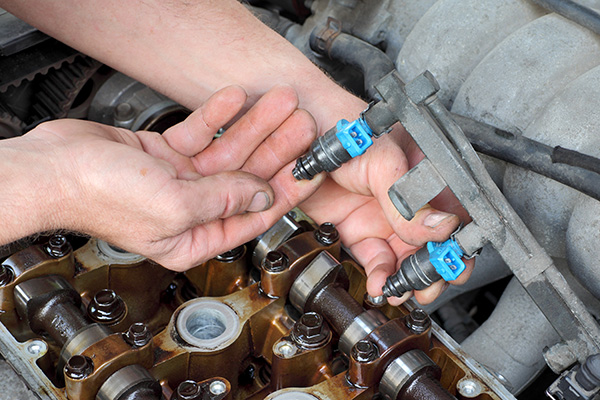
We spend a lot of time checking on the big, obvious components under the hood. It is easy to notice when a battery dies, a belt squeals, or a radiator hose starts spraying bright green fluid all over the driveway. Those are the loud, dramatic car problems that demand your immediate attention. But some of the most frustrating performance issues stem from components that are barely larger than a standard ballpoint pen.
At our shop, we talk to drivers every day who complain that their vehicle has simply lost its old spunk. They tell us the car feels lazy when merging onto the highway, shakes uncomfortably when sitting at a red light, or is suddenly chugging gas. When we hook up our diagnostic equipment, the culprit often turns out to be a set of dirty fuel injectors. Let us take a look at what these tiny marvels actually do, why modern cars make them get dirty faster than older models, and how a microscopic bit of carbon can ruin your daily drive.
The Anatomy of the Perfect Mist
To appreciate how a dirty injector throws a wrench into your morning commute, you have to understand the incredible precision required by a modern engine. Fuel injectors are essentially high-speed, electronically controlled misting nozzles. Their sole job is to take highly pressurized gasoline from the fuel system and spray it straight into the engine.
However, they do not just dump raw liquid gasoline into the cylinder. Liquid gas does not burn easily or efficiently. Instead, the injector forces the fuel through microscopic holes, creating an incredibly fine, even mist.
Think of it like a high-end paint sprayer. When the nozzle is perfectly clean, you get a beautiful, microscopic cone of vaporized mist that mixes perfectly with incoming oxygen. This ideal mixture ignites cleanly and evenly, giving you maximum horsepower, smooth acceleration, and excellent fuel mileage.
What Most Drivers Don't Know: The GDI Problem
Many drivers believe that buying top-tier gasoline completely protects their fuel system from getting dirty. While high-quality gas helps, modern engine design has changed the rules of the game in a way that most people do not realize.
If your vehicle was built within the last decade, there is a very high chance it uses a system called Gasoline Direct Injection, or GDI.
In older cars, fuel injectors sprayed gasoline into the intake manifold, upstream of the cylinders. This meant the fuel constantly washed over the engine’s intake valves, keeping them clean. In a modern GDI engine, the injectors are moved. They are placed directly inside the combustion chamber itself, exposing the delicate tips of the nozzles to the brutal, fiery explosions of the engine.
Every single time you turn off your engine, a tiny amount of residual heat rises up through the block. Because the injectors live right inside the fire zone, this extreme heat bakes the tiny droplets of fuel left sitting on the nozzle tip, turning it into a hard, black crust known as carbon varnish. Because GDI engines operate under immense pressure, even a microscopic layer of this varnish can distort the fuel spray pattern completely.
The Domino Effect on Your Engine
When carbon build-up forms over those tiny nozzle holes, it ruins your engine's rhythm. Instead of a fine, vaporized mist, the injector begins to shoot an uneven stream or heavy droplets of raw liquid gas.
The Hesitation and Misfire: Liquid fuel droplets take much longer to burn than a fine mist. If the fuel cannot ignite fully during the brief millisecond the spark plug fires, your engine will experience a misfire. You will feel this as a sudden jerk or a rough, vibrating sensation when you are idling at a red light.
The Tailpipe Trap: When your spray pattern is compromised, unburned liquid gasoline gets pushed right out your exhaust valves. This unburned fuel travels straight down your exhaust system and into your expensive catalytic converter, overheating the unit and potentially melting it from the inside out.
The Dangerous Lean Condition: A severely clogged injector delivers less fuel than the computer expects. This creates a lean air-fuel mixture, meaning there is too much oxygen and not enough gas. A lean mixture burns incredibly hot, which can eventually melt spark plug tips or burn a physical hole straight through an aluminum piston.
Why the Bottles on the Supermarket Shelf Fall Short
A lot of drivers notice their car running a bit rough and decide to buy a cheap bottle of fuel injector cleaner from a local auto parts store. While pouring an additive into your gas tank is fine as a preventative maintenance step for older vehicles, it rarely solves the problem once a modern GDI engine starts misfiring.
Because those hard carbon deposits are baked on by internal combustion temperatures, a diluted additive in a full tank of gas simply cannot scrub the nozzle tips clean. When you bring your vehicle to our team, we perform a professional, localized fuel injection service. We hook specialized equipment directly to your engine's fuel rail, completely bypassing your gas tank. We run the engine on a highly concentrated, commercial-grade cleaning solvent that safely dissolves the carbon crust from the inside out, restoring that perfect, factory-spec misting pattern to every single cylinder.
Let Us Restore Your Passing Power
You do not have to live with a sluggish engine, a shaky idle, or skyrocketing fuel bills. Our experienced technicians know exactly how to read your vehicle's live computer data to pinpoint which injectors are struggling and clear the blockage safely. We want to help you get that crisp, responsive, fun-to-drive feeling back into your daily commute.
Stop by Goss' Garage II in Gambrills, MD or book your professional fuel system cleaning online today, and let our team get your engine running sharp, smooth, and efficient!