A fuel gauge that stays on full for too long, drops suddenly, or reads empty shortly after a fill-up can make every drive less predictable. The difficult part is that the component you see on the dashboard is only the last step in a system that begins inside the fuel tank.
The sending unit, wiring, instrument cluster, control modules, and gauge display all have to agree before the reading makes sense. When they don't, the gauge's behavior can offer clues, but testing is usually needed to separate an in-tank problem from an electrical or display issue.
What the Fuel Sending Unit Does
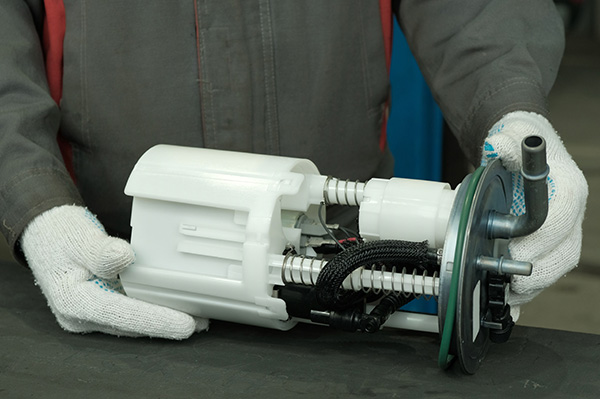
The fuel sending unit measures how much fuel is in the tank. A common design uses a float attached to an arm that moves across a variable resistor as the fuel level changes. That changing resistance becomes the signal the vehicle uses to determine fuel level.
On many vehicles, the sending unit is incorporated into the fuel pump module. Others use a separate sender, and some vehicles with complex tank shapes use more than one fuel level sensor. Because the sender lives inside the tank, reaching it may require removing the fuel tank or accessing the pump module through a service opening.
What the Fuel Gauge Does
The fuel gauge is the display that shows the driver the interpreted fuel level. On older vehicles, the sender signal may have a relatively direct relationship with the gauge. Newer vehicles can route fuel level information through one or more electronic modules before it appears in the instrument cluster.
That distinction is important because an inaccurate display does not automatically mean the sender has failed. NHTSA records include manufacturer recalls where inaccurate fuel readings were caused by instrument-cluster or control-module software rather than a defective in-tank sensor.
Signs That Point More Toward the Sending Unit
A worn sender can develop dead spots in its resistive element, and the float or arm can stick at certain positions. Delphi notes that sender wear can cause gauges to stay full or empty, or fluctuate as the float moves through damaged areas.
Certain patterns may direct attention toward the sender:
- Gauge sticks at the same fuel level repeatedly
- Reading suddenly jumps after hitting bumps
- Gauge drops from one level to another instead of moving gradually
- Reading becomes accurate again after fuel sloshes in the tank
- Gauge stays empty after refueling
- Gauge stays full while fuel is clearly being consumed
Those symptoms are useful clues rather than proof. Wiring faults can imitate several of them.
When the Gauge or Instrument Cluster May Be Responsible
The dashboard side becomes more suspicious when the sending unit produces a correct signal, but the displayed level does not match it. Delphi's testing guidance notes that gauge operation can be checked independently from sender output to help determine which side of the system is faulty.
Instrument cluster faults are less common than sender problems on many vehicles, but they do happen. Manufacturer recalls have documented inaccurate fuel displays caused by software logic or incorrect programming even though the fuel level hardware itself was not the root cause.
Wiring Can Make Either Component Look Bad
The sender and gauge need an intact electrical path between them. A damaged wire, corroded terminal, poor ground, or short circuit can distort the signal before it reaches the display.
For that reason, replacing the sending unit simply because the gauge is wrong can lead to unnecessary work. Delphi identifies wiring and ground faults as possible causes of full, empty, or erratic fuel readings. An inspection of the circuit is especially important when the symptom began after fuel tank work, collision repair, water intrusion, or other electrical repair.
Can the Gauge Reading Be Wrong Even When Both Parts Work?
Yes. Modern vehicles may calculate and filter fuel-level information electronically rather than sending the gauge signal directly from the sender. Software, module communication, tank shape, and multiple fuel sensors can all affect the final reading.
A recent Mazda recall involving certain CX-70 and CX-90 vehicles, for example, addressed inaccurate fuel gauge readings through a body control module software repair. That type of vehicle-specific problem is one reason technicians check service information and scan data before assuming a physical sender or gauge has failed.
How Technicians Separate a Bad Sender From a Bad Gauge
Testing usually starts by comparing the actual fuel level with the data the vehicle reports. A scan tool may show the fuel level sensor value or values being received by the control modules. Technicians can then compare that information with what appears on the dashboard.
Depending on the design, they may also measure sender resistance, check voltage and ground, inspect connectors, and test whether the gauge responds correctly through its expected range. Delphi specifically recommends testing sender output and gauge operation to separate the two faults. If the sender produces an incorrect or interrupted signal, the issue is likely near the tank. If its signal is correct but the displayed reading is not, testing moves toward wiring, modules, or the instrument cluster.
Why an Incorrect Fuel Reading Should Be Repaired
An unreliable gauge is more than an inconvenience. Several manufacturer recalls have identified the risk of vehicles unexpectedly running out of fuel when the gauge indicates more fuel than is actually available.
Fuel level components do not normally have a routine replacement interval as part of regular maintenance. When the gauge begins sticking, jumping, or giving readings that do not match refueling history, testing the system is a better approach than relying on mileage estimates or resetting the trip odometer indefinitely.
Get Fuel Gauge and Sending Unit Service in Gambrills, MD, With Goss' Garage II
Goss' Garage II in Gambrills, MD, can diagnose inaccurate fuel gauges, sending unit faults, wiring issues, and related instrument cluster problems.
If your gauge is stuck on full, drops unexpectedly, or can no longer be trusted to show how much fuel remains, contact Goss' Garage II to schedule service.